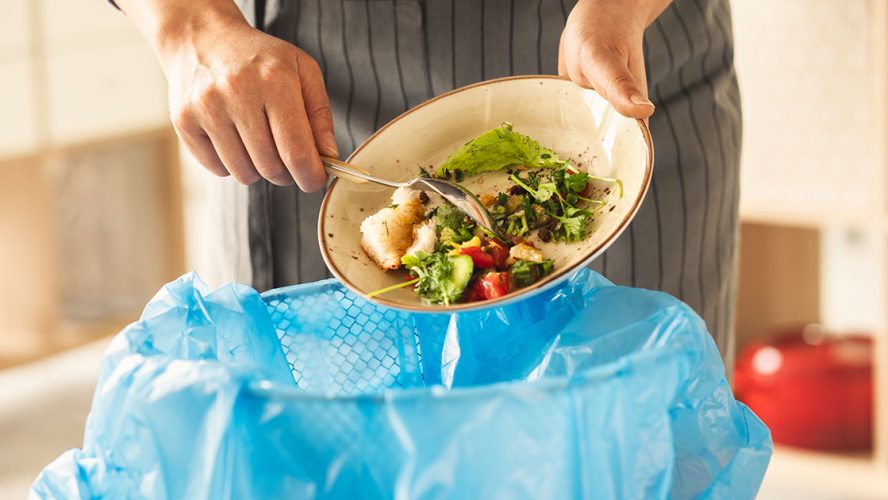
Nearly a third of America’s food supply goes to waste each year, costing families thousands of dollars and the planet dearly.
Imagine walking out of the supermarket with three bags filled to the brim with groceries. As you make your way to your car, instead of loading all three bags into the trunk, you toss one into a trash can. Sounds silly, right? Yet that is essentially what happens with a third of our food supply.
In the United States, we let nearly 30 percent of our food supply go unsold or uneaten. That’s almost 115 billion meals’ worth of food that we’re letting go to waste each year, when 1 in 7 Americans is food insecure. The value of this food waste is close to $340 billion. Consumers, who are responsible for close to 50 percent of food waste between uneaten groceries and restaurant plate waste, spend over $750 each every year on food that goes uneaten. For a family of four, that’s more than $3,000 annually. And this is happening against a backdrop of elevated food prices.
Your wallet is not the only thing that is negatively affected by our wasted food. The production, distribution, storage, preparation, and ultimate disposal of unsold or uneaten food contribute to the same greenhouse gas emissions as 51 million gas-powered vehicles driven for a full year. It also consumes more than 15 percent of all U.S. freshwater and cropland. Nearly a quarter of what we send to the landfill is uneaten food, in a country with rapidly decreasing landfill space.
Five ways to reduce food waste at home
Fortunately, there are some pretty basic things you can do that make it easy, economical, and — yes — delicious to save food in your home. Start with these five easy-to-use strategies to get the most out of the food you’re buying.
- Plan ahead: Think ahead a few days or a week to consider what you’ll be eating before you buy groceries.
- Store your food properly: Different foods need to be stored differently, and they’ll last a lot longer when they’re stored properly.
- Use your freezer: Freezing food is a great way to extend its life. You can freeze most anything, including cheese, milk, pasta, and even that half jar of unused pasta sauce.
- Learn the labels: Date labels typically refer to quality, not safety. Major food industry groups have endorsed the use of “use by” to indicate when a product should be discarded for food safety reasons and “best if used by” to indicate that the date is about quality and the food can be consumed beyond that date.
- Eat down: As you’re planning ahead for what you’ll be eating for the week, plan a day to “eat down” all the leftovers and excess food collecting in your fridge.
To learn more about the food waste problem and solutions to address it, visit refed.org.
