
Every single food scrap that ends up in a landfill breaks a natural cycle that has sustained life on Earth for millions of years.

Sung Ho Park
Chief Marketing Officer, Reencle
For most of human history, food scraps returned to the ground. Peels, cores, and kitchen trimmings decomposed naturally, feeding the soil that would grow the next season’s harvest. That loop is now broken. Today, the average American household sends roughly 4 lbs. of food waste to the landfill every week — organic matter that will never find its way back to the earth that produced it.
The consequences of the broken loop show up in the soil. According to the USDA Natural Resources Conservation Service, the United States has lost roughly half of its topsoil over the past 150 years, driven largely by the depletion of organic matter. Soil without organic matter becomes compacted and lifeless — less able to hold water, support root systems, or produce nutrient-dense food. It also becomes more vulnerable to drought and erosion, amplifying the instability of a food system already under pressure. The irony is that what soil needs most is exactly what we’re throwing away.
Not everything marketed as a composting solution delivers actual compost. Some appliances simply dehydrate food scraps, producing a dry powder that lacks the living microbial populations that give compost its value. Dehydrated waste is still waste — reduced in volume, but biologically inert. Real compost is something different entirely: the product of active biological transformation, in which living microorganisms break down organic material into humus, a stable soil amendment that restores the communities plants and food systems depend on. The distinction matters, because only one of these (composting) actually closes the loop.
The USDA notes that a teaspoon of biologically healthy soil contains more living organisms than there are people on Earth. Compost is what feeds them. Without a steady return of organic matter, those communities collapse — and with them, the soil’s capacity to sustain life.
Despite broad public awareness that composting is beneficial, actual participation remains low. The barriers are practical: outdoor bins require space and attention, municipal composting programs are unevenly available, and the perceived difficulty of managing food scraps at home discourages most households before they begin. The result is a wide gap between knowing and doing — and a continued flow of organic matter into the waste stream that could instead be rebuilding degraded soil.
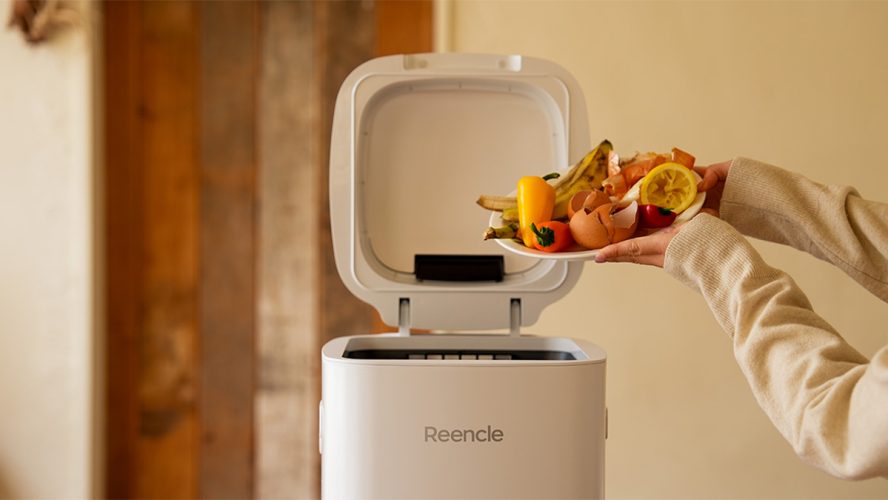
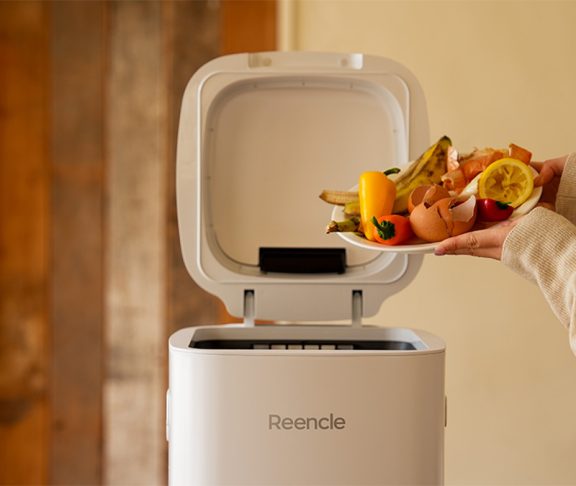
Over 300,000 households in 19 countries have already made food-scrap composting part of their daily routine with Reencle — not as a sacrifice, but as a natural extension of how they think about what they consume and what they return. Using continuously active living microorganisms, Reencle breaks down food scraps indoors, producing ready-to-use compost in as little as 30 days, with no odor and no outdoor space required. Nearly any food scrap — vegetable peels, fruit cores, cooked grains, coffee grounds — becomes feedstock for the same biological process that healthy forest soils rely on.
The impact of that process, scaled across households, is measurable. Each Reencle unit diverts the equivalent of approximately 0.39 metric tons of CO2 per year — the same as not driving a car for more than a month.
The compost that comes out feeds gardens, window boxes, potted plants, and community plots — returning to the soil exactly what was taken from it. It improves water retention in sandy soils, loosens compacted clay, and reintroduces the microbial diversity that makes ground fertile rather than merely present. That’s not a product feature. That’s the loop, closed: organic matter that began as a meal, completing its return to the earth that made it possible.
This Earth Day, the most meaningful shift may not be the largest one. It starts with understanding where your food scraps belong — and building a daily habit around sending them back. Soil restored one household at a time is still soil restored. And the cycle that has sustained life on this planet for millions of years is patient enough to wait for us to remember how it works.
To learn more, visit reencle.co
