

The origins of Amazon’s disaster relief program highlight how companies and organizations can lean into what they excel at to help with disaster relief.
In 2004, an undersea earthquake 150 miles off the coast of Indonesia triggered a massive tsunami in the Indian Ocean. Waves reached 100 feet tall and decimated nearby islands, shaping up to be one of the worst natural disasters in modern history.
At the time, Bettina Stix was working at Amazon when a few software engineers asked her to add a donation button to the Amazon homepage to help those affected by the tsunami. It took three long days, but the company raised $15 million in disaster relief.
“This experience stuck with me for a long time,” Stix said.
Out of the disaster came an idea for Stix: “What if we did more than a button on the homepage? What if we could stand on the shoulders of Amazon and everything that Amazon is good at, like logistics, operational excellence, and resources to help in disasters?”
From there, Amazon disaster relief was born in 2017. Today, the company has donated and delivered more than 30 million emergency supplies and technology in response to 200+ disasters around the world.
Now, Stix recommends that other leaders invest in disaster-relief preparations.
Leaning on Amazon’s resources
Disaster relief often happens ad hoc, meaning companies and organizations jump into action after the disaster has already begun. Stix says it doesn’t have to be that way.
One of the main objectives of the Amazon disaster relief program is to prepare supplies in advance so they can reach victims of natural disasters as quickly as possible. They do this by using Amazon trucks, airplanes, and fulfillment centers.
For example, Stix explained that heavy-duty tarps are essential, especially after a hurricane. The faster a person receives one, the less likely their house is to develop mold. They could also use the tarp to sleep on and cover up debris. These tarps, along with other supplies, sit on large pallets around the world, ready to be shipped at a moment’s notice.
“For every dollar you spend in preparation, you save $15 in recovery,” Stix said.
In June, Venezuela experienced two back-to-back earthquakes. Homes were destroyed, people were displaced, and the death toll climbed.
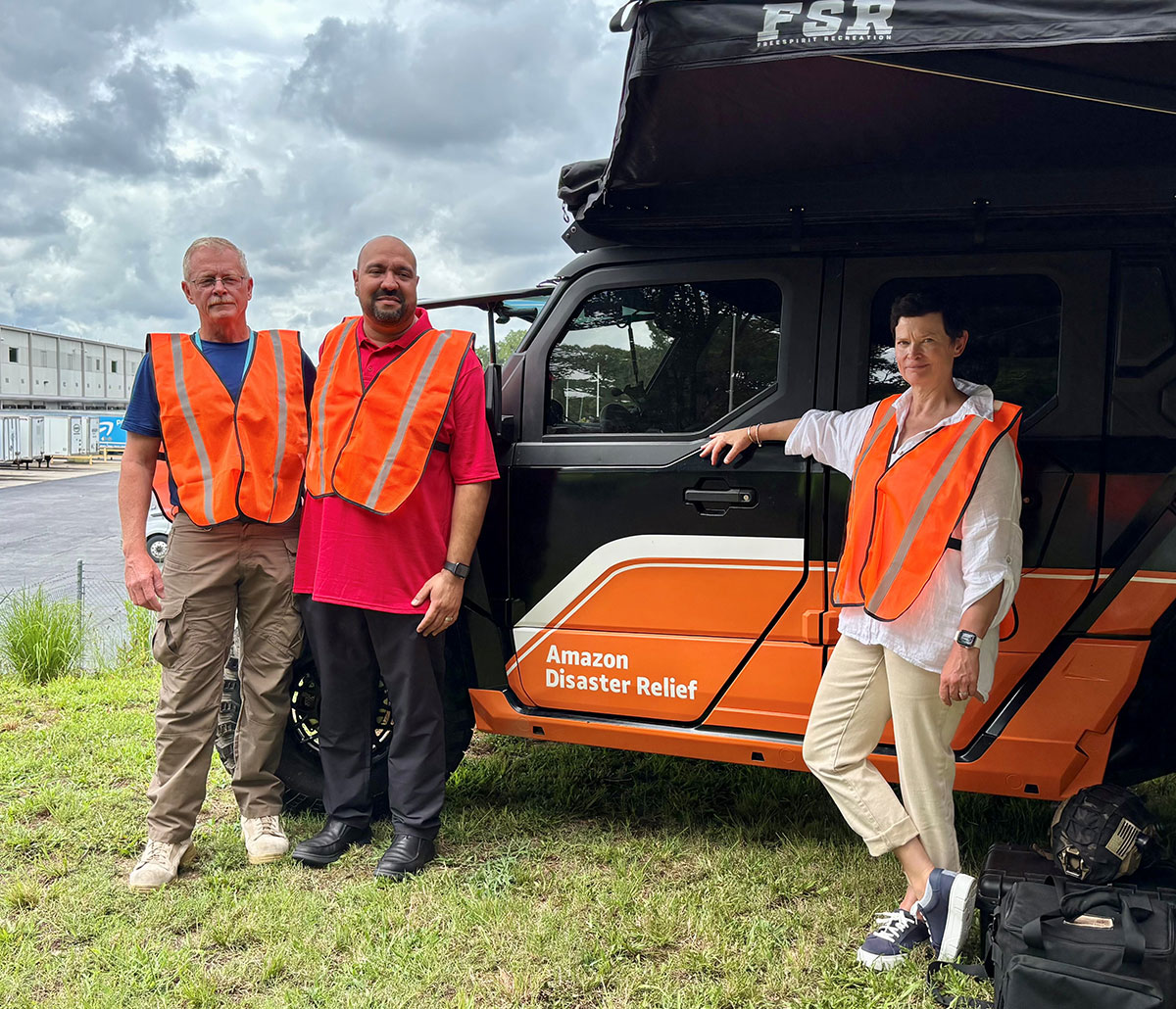
Stix and her team jumped into action, sending an Amazon Air flight to Caracas to donate and deliver approximately 690,000 supplies — including sleeping bags, tarps, generators, water filters, diapers, cleaning equipment, and hygiene kits — to nonprofits on the ground. Then, in collaboration with Airlink, the U.S. State Department, and the United Nations World Food Programme, Amazon established a humanitarian airbridge — seven weekly relief flights to Venezuela delivering critical supplies to nonprofits who could put them to use immediately.
Other leaders can prepare for disaster relief, too
Stix said company leaders should care about their employees and their families first.
“Know where your employees are from,” she said, “so you know if they’re affected by a disaster. It goes a long way.”
Companies then need to know their “secret sauce,” just as Amazon did with its program.
“Concentrate on what you’re good at,” Stix said. “Whether it’s your scale or your services, use your strengths to make a positive impact in communities.”
Disaster relief is a team sport that doesn’t happen at a moment’s notice, but requires years of preparation across multiple stakeholders.
“Disaster relief works best when the world comes together, when everyone does their part, and when we all play a role,” Stix said.
